
⭐️⭐️⭐️¾ (3.75 out of 5 stars)
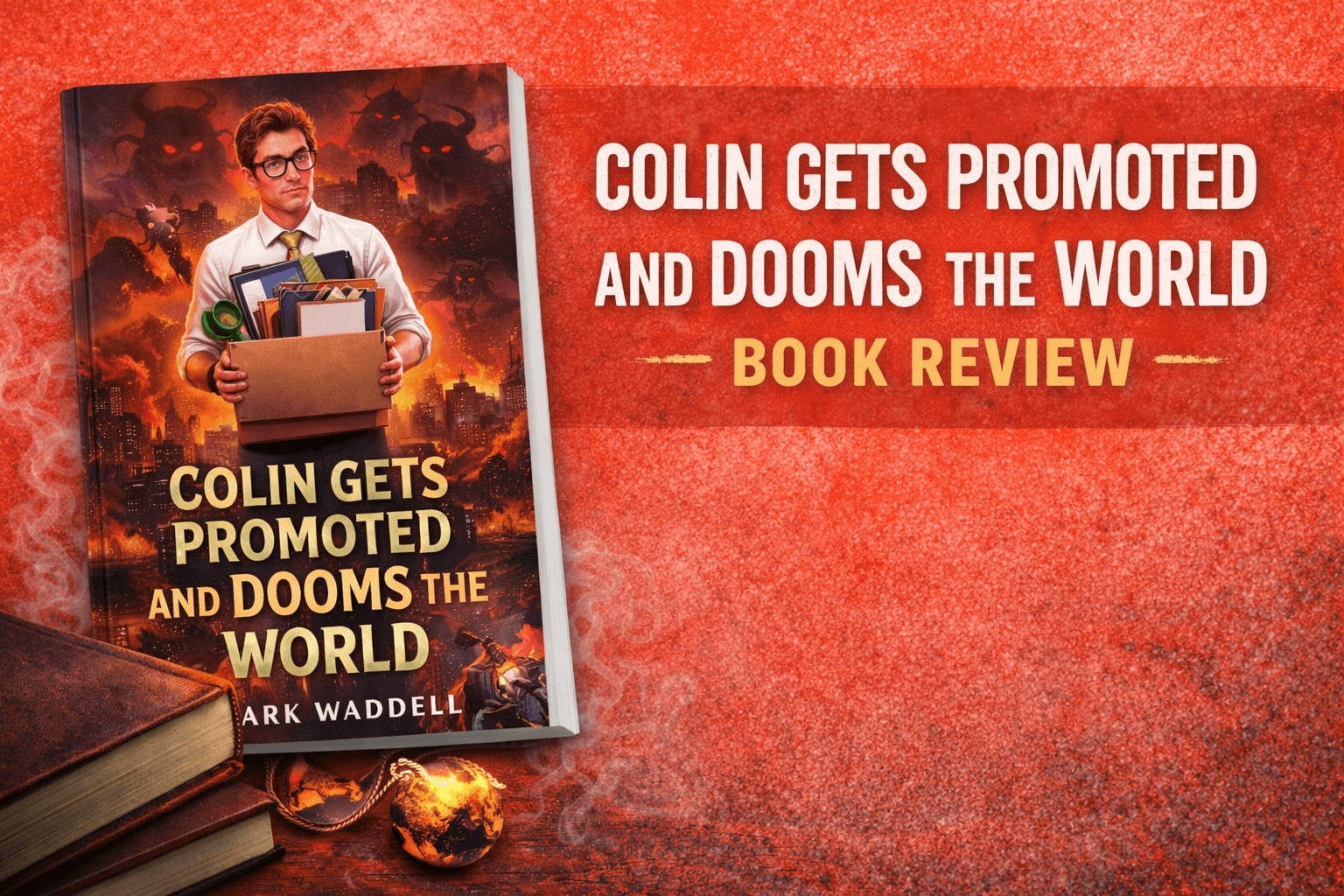
In this Colin Gets Promoted and Dooms the World review, we’re looking at a novel that takes one of the most universal modern anxieties — corporate life — and fuses it with eldritch horror, dark comedy, and a surprising amount of heart. Written by Mark Waddell, this book imagines what might happen if climbing the corporate ladder didn’t just cost your soul metaphorically, but quite literally endangered the fate of the world.
The result is a novel that is clever, strange, often very funny, and occasionally uneven. At its best, it skewers office culture with a scalpel; at its weakest, it leans a little too hard on its central joke. Still, there’s enough originality here to make Colin Gets Promoted and Dooms the World stand out in a crowded field of comic fantasy and workplace satire.
What Is Colin Gets Promoted and Dooms the World About?
Colin is not a hero. He’s not especially brave, principled, or altruistic. He’s an anxious, overworked employee at Dark Enterprises, a corporation whose name is less metaphorical than it first appears. At Dark Enterprises, performance reviews are brutal, layoffs are fatal, and upper management may or may not be ancient cosmic beings.
When Colin faces imminent termination — the permanent kind — he does what many desperate employees might do: he cuts a deal. That deal results in a promotion, a sudden boost in status, and a cascade of unintended consequences that spiral rapidly out of control. In an attempt to save his job, Colin triggers events that threaten to unravel reality itself.
From there, the novel follows Colin as he attempts to juggle corporate expectations, apocalyptic fallout, office politics, and a budding romantic relationship, all while eldritch forces loom ever closer. The plot unfolds as a blend of workplace farce and supernatural escalation, with memos, meetings, and middle management serving as gateways to horror.
Tone and Genre: What Kind of Book Is This?
One of the most common questions readers ask is: What genre is Colin Gets Promoted and Dooms the World? The answer is: several, at once.
This is primarily a dark comedy, rooted in satire of corporate culture and ambition. It’s also fantasy, drawing on Lovecraftian horror, demonic bargains, and cosmic entities. There are elements of horror, although rarely intended to terrify, and even a light romantic subplot that adds emotional depth.
The tone leans irreverent and cynical, but not mean‑spirited. Waddell clearly enjoys skewering systems rather than individuals, and much of the humor comes from how recognizable Dark Enterprises feels — just exaggerated to a horrifying extreme. If you’ve ever felt like your workplace worships unknowable gods, this book will feel uncomfortably familiar.
What Works Well
Corporate Satire That Actually Lands
The strongest element of Colin Gets Promoted and Dooms the World is its satire. Dark Enterprises isn’t just a funny setting; it’s a sharp exaggeration of modern corporate life. The book nails the language of bureaucracy, the emptiness of mission statements, and the quiet cruelty of systems that reward ambition without ethics.
Performance metrics, promotion structures, and internal politics are treated as sacred rituals, and the joke works because it’s grounded in truth. Many readers will recognize the absurdity of meetings that feel ritualistic, rules that seem arbitrary, and leadership that feels detached from reality. Waddell turns that recognition into comedy by making the stakes literally apocalyptic.
Humor That’s Dry, Dark, and Consistent
The humor here is not slapstick or broad. It’s dry, ironic, and often bleak in the best way. Much of the comedy comes from understatement — from Colin reacting to increasingly insane circumstances with weary resignation rather than heroic outrage.
There are laugh‑out‑loud moments, particularly when corporate jargon collides with supernatural horror. A demonic ritual framed like a quarterly initiative, or an existential threat treated as an HR issue, never quite stops being funny. Readers who enjoy satire that trusts them to get the joke will feel rewarded.
Inventive Worldbuilding
While the book isn’t heavy on lore dumps, the worldbuilding is imaginative and effective. Dark Enterprises feels fully realized, from its office hierarchy to its sinister sublevels. The supernatural elements are woven into the corporate structure rather than existing alongside it, which strengthens the central metaphor.
The cosmic horror elements are intentionally vague, borrowing more from the idea of Lovecraftian dread than from explicit mythology. This keeps the focus on tone rather than exposition and allows the satire to stay front and center.
Where the Book Falls Short
An Uneven Character Arc
One of the most frequent criticisms in reader reviews is that Colin doesn’t change very much. He begins the novel self‑interested, passive, and motivated primarily by survival and comfort — and largely remains that way.
For some readers, this is the point. Colin is a stand‑in for how systems reward moral inertia. But others may find his lack of growth frustrating, especially as the stakes escalate. There are moments where deeper self‑reflection or consequence could have strengthened the emotional payoff.
The Romance Feels Underdeveloped
The romantic subplot adds warmth and contrast, but it often feels rushed. The relationship provides moments of levity and humanity, yet it never quite integrates fully into the main narrative. Readers looking for a meaningful romantic arc may find it serviceable but thin.
Pacing Issues in the Middle
While the opening and ending are strong, the middle section of the book occasionally drags. Certain beats repeat, and the escalation temporarily stalls. A tighter edit could have maintained momentum without sacrificing humor or theme.
Author Context
Mark Waddell writes at the intersection of dark humor, speculative fiction, and social satire. His work often explores how ordinary people navigate systems that are far larger, stranger, and more dangerous than they first appear. In Colin Gets Promoted and Dooms the World, Waddell applies this lens to modern corporate culture, exaggerating its rituals and hierarchies into cosmic horror. This approach places the novel firmly within the tradition of satirical fantasy that uses humor to critique power, ambition, and institutional indifference.
Themes: What Is the Book Really About?
Beneath the jokes and horror, Colin Gets Promoted and Dooms the World is about ambition without accountability. It asks what happens when systems reward compliance over conscience, and when survival within a structure matters more than the harm that structure causes.
Colin’s deal is not unusual — it’s just exaggerated. Many readers will recognize the temptation to compromise, rationalize, and defer responsibility to stay afloat. The novel suggests that this mindset, scaled up, leads to catastrophe.
There’s also a quieter theme about passivity. Colin rarely chooses evil; he allows it. That distinction is crucial to the book’s satire and explains why his arc is intentionally muted.
Who This Book Is For / Not For
This book is for you if:
- You enjoy dark comedy and cynical workplace satire
- You like fantasy or horror concepts used as metaphors rather than pure genre spectacle
- You appreciate absurd, off-beat premises that poke fun at modern corporate culture
- You enjoy humor similar to Douglas Adams or Terry Pratchett, but darker and more cynical
This book is not for you if:
- You want a traditional heroic character arc with strong personal growth
- You prefer tightly plotted stories with fast, consistent pacing throughout
- You are looking for straight horror or high fantasy played completely seriously
- You dislike satire that leans heavily on workplace and corporate themes
Common Questions People Ask
Is Colin Gets Promoted and Dooms the World funny?
Yes. The humor is dark, dry, and rooted in satire. If you enjoy workplace comedy with a cynical edge, this book delivers.
Is this book scary?
Not in a traditional horror sense. The supernatural elements are more absurd and unsettling than frightening.
Who should read this book?
Readers who enjoy dark comedy, corporate satire, absurd fantasy, and stories that poke fun at modern work culture.
Is it similar to Terry Pratchett or Douglas Adams?
In tone, yes — particularly in how it blends humor with big‑picture ideas — though it leans darker and more cynical.
Does the ending resolve everything?
The ending provides thematic closure rather than a neat resolution. It’s fitting, if not universally satisfying.
Final Verdict
At 3.75 out of 5 stars, Colin Gets Promoted and Dooms the World is an inventive, funny, and sharply observant novel that doesn’t quite reach greatness but comes impressively close. Its satire is smart, its premise memorable, and its humor consistently effective.
Readers looking for a polished character arc or deep emotional transformation may find it lacking. But for those who enjoy dark humor, corporate absurdity, and the idea that the real horror might be middle management, this book is well worth the read.
If nothing else, this Colin Gets Promoted and Dooms the World review confirms one thing: sometimes the scariest monsters aren’t ancient gods — they’re just climbing the ladder.
/custom